Case Study
Marine Biology
The foundational degree in marine life, and the route into most of the graduate work that follows it. Field work starts in the first year.

The foundational degree in marine life, and the route into most of the graduate work that follows it. Field work starts in the first year.
Marine Biology is the largest program at Northmoor and the one most people mean when they write to ask about studying the ocean. It is a full biology degree taught in a marine setting: cells, genetics, evolution and ecology, with the organisms and the water they live in supplying the examples throughout.
You will be in the field in your first year. Students in this program spend nights at Prentice Coastal Field Station from the first spring, walking transects that have been surveyed continuously since 2004, and the courses that involve the most cold water fill first every year.
The first two years build the core: introductory marine biology, general oceanography, environmental science foundations, and invertebrate zoology. The third and fourth years open out into fish biology, marine botany, reef ecology and molecular ecology, with room for courses from the aquaculture and policy programs.
The molecular strand is worth flagging because it is where the field is moving. Environmental DNA lets a liter of seawater stand in for a survey, and learning both what that delivers and where it quietly fails is a genuinely marketable thing to be able to do.
Graduates go into environmental consulting, state and federal agency science, aquaculture, education, and graduate study. The last is the largest single destination, and it is worth being direct about why.
Several specializations at Northmoor are graduate programs, not undergraduate ones. Marine mammal science is the clearest case. If that is what you want to do, this degree is the route: it gives you the population biology and statistics that the master's program assumes you already have. Students who arrive wanting marine mammals and leave four years later doing exactly that are a normal outcome, not a redirection.
Cold water and early starts. Tide work does not respect a timetable, and a good deal of the field schedule is set by the moon rather than by the registrar. Students who come to visit in February tend to know what they are signing up for.
The first-year foundation in marine life: cells, inheritance, evolution and the diversity of organisms, with the local shoreline as the standing example.
1The ocean as a physical, chemical, geological and biological system. Taken by students across every program here.
1The systems view: energy, matter, populations and the human pressures acting on all three, with coastal examples throughout.
1The major invertebrate groups, their body plans and their ecology, taught largely through specimens collected on the shore.
1Marine plants and algae, from microscopic phytoplankton to seagrass meadows, and the habitats they build.
1The biology of fishes, from physiology and life history to the population processes that fisheries management depends on.
1Reef ecosystems, the symbiosis that builds them, and what the last three decades of disturbance have shown about recovery.
1Molecular methods in marine ecology, including environmental DNA, and an unusually careful account of what those methods do not deliver.
1.5Yes, for all students entering directly from high school. Transfer students are housed as space allows, and the waitlist usually clears by mid-July.
Accordion content - Officiis porta iusto luctus maecenas ultricies libero quisquam commodi do sequi facilisis, accusamus aut? Sapien dignissim nascetur nesciunt phasellus eros dis cupidatat tempor egestas cillum eveniet lobortis, sunt eos tellus atque quaerat, voluptatem exercitationem voluptatibus nesciunt, eveniet in dicta quae.
Accordion content - Officiis porta iusto luctus maecenas ultricies libero quisquam commodi do sequi facilisis, accusamus aut? Sapien dignissim nascetur nesciunt phasellus eros dis cupidatat tempor egestas cillum eveniet lobortis, sunt eos tellus atque quaerat, voluptatem exercitationem voluptatibus nesciunt, eveniet in dicta quae.
Accordion content - Officiis porta iusto luctus maecenas ultricies libero quisquam commodi do sequi facilisis, accusamus aut? Sapien dignissim nascetur nesciunt phasellus eros dis cupidatat tempor egestas cillum eveniet lobortis, sunt eos tellus atque quaerat, voluptatem exercitationem voluptatibus nesciunt, eveniet in dicta quae.
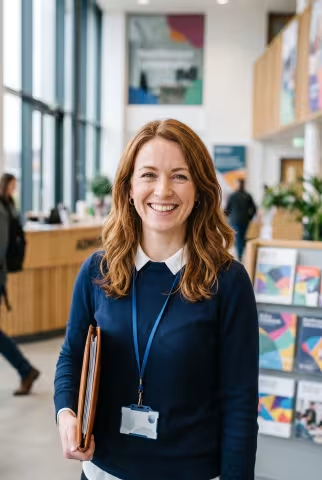
Professor of Marine Ecology
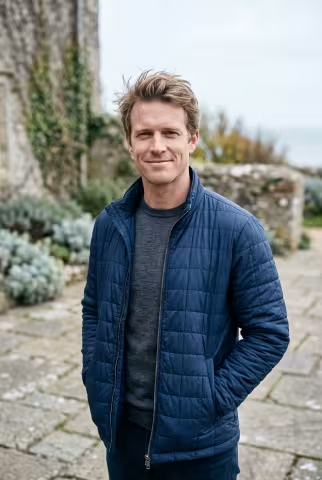
Associate Professor of Biology